

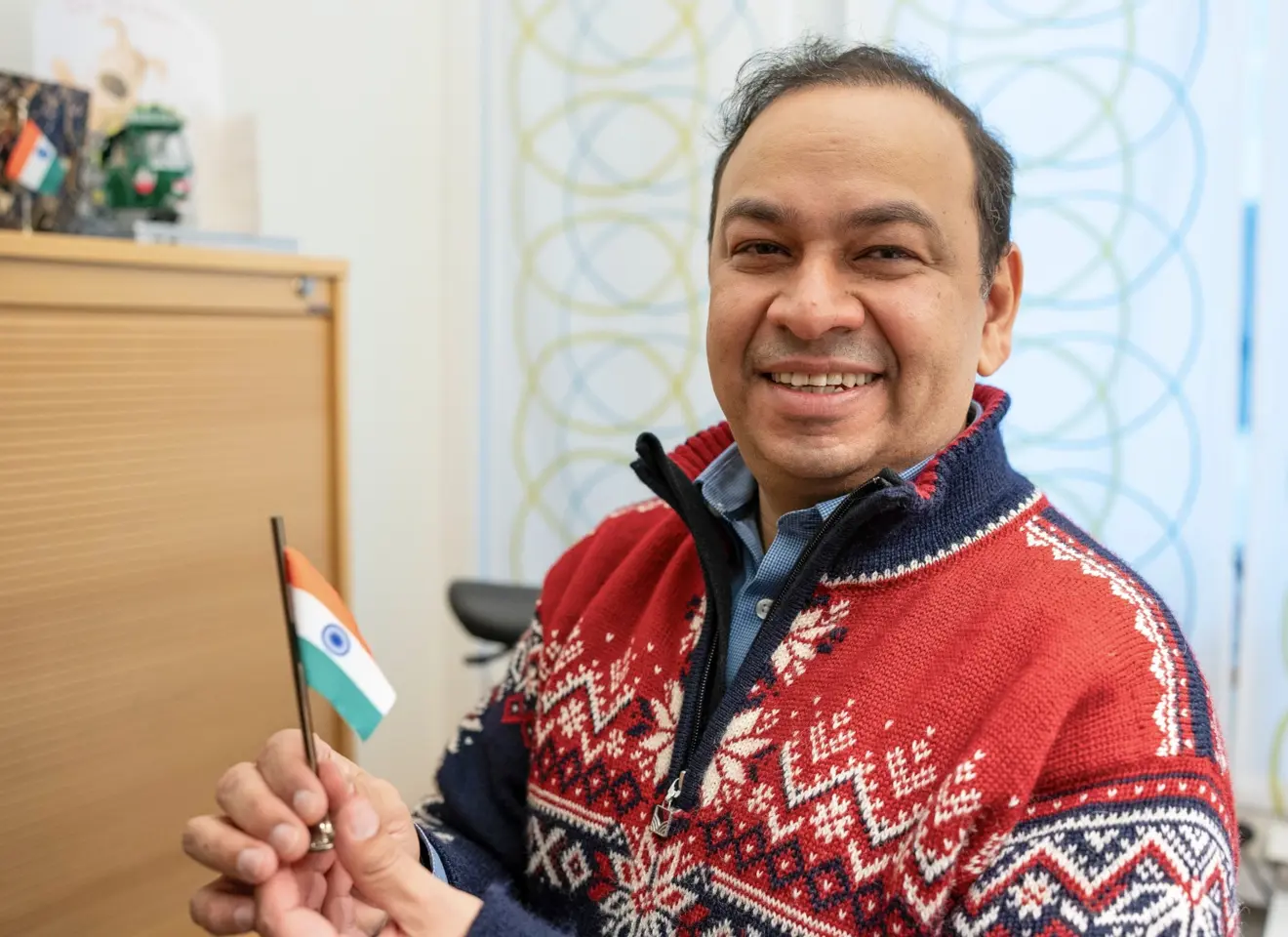
TWO SIMILARITIES: Rafi Ahmad finds that the priority given to family and the practice of religion are two things Norway and his own Indian background have in common. Photo: University of Inland Norway
Only two countries top Norway on immigrant PhDs
Statistics Norway has identified more than 5,000 additional immigrants with a PhD in Norway than previously assumed. In 2024, Norway had the third-highest share of foreign-born PhD holders in the OECD, and most of this is accounted for by the STEM subjects.
Norwegian-Indian Rafi Ahmad is part of a large-scale Norwegian drive to recruit research expertise from abroad.
'Quality of life for the family and strong research communities were the deciding factors.'
This recruitment is now proving to be far more extensive than previously assumed. The increase emerges from new figures from ReICO, the Research and Innovation Careers Observatory, an analysis project run jointly by the OECD and the European Commission. The Norwegian figures were reported to ReICO by Statistics Norway.
'The reason for the jump in the number of people with a PhD from 2023 to 2024 is that Statistics Norway has started using a new data source for information about immigrants with a PhD,' says Kaja Wendt, head of group in the Division for R&D, Technology and Business Development at Statistics Norway.
'This concerns information about doctoral degrees taken abroad, drawn from the R&D Survey. As a result, the total number of employed people with a PhD in the workforce for whom we hold individual-level data rose from 41,189 to 46,281.'
Tekna is a natural choice for all PhD candidates who are pursuing their degrees in STEM subjects.
Leading the fight against antibiotic resistance
Ahmad, mentioned above, is one of the many immigrants with a PhD in Norway. He is a professor of biotechnology at the University of Inland Norway, and an adjunct professor (Professor II) at UiT The Arctic University of Norway and at the University of Southampton. Ahmad is best known for his leading role in the fight against antibiotic resistance.
'I took my bachelor's degree in India, my master's degree in England and my PhD in Tromsø. I later worked in Norway, Germany and Sweden, before accepting a position as associate professor at what was then Inland Norway University of Applied Sciences in 2015.'
Ahmad, who is a Tekna member, came to the post in 2015 from a job in Sweden with the Anglo-Swedish pharmaceutical company AstraZeneca.
'Quality of life for the family and strong research communities were the deciding factors in our moving back to Norway. If I had been mainly concerned with a leading international career, I would have applied to England or the United States instead.'
Third highest in the OECD
The new figures from ReICO, mentioned above, show that Norway had the third-highest share of foreign-born PhD holders in the OECD in 2024. Admittedly, only 14 countries reported figures for that year, but 36 countries have reported figures over recent years.
'The share of foreign-born residents among those with a PhD is high in Norway, at almost 56%. Only Switzerland and Luxembourg had a higher share in 2024. My view is that the high share may be connected to well-regulated terms of employment and a generally high level of pay in Norway,' says Wendt of Statistics Norway.
Only New Zealand and Canada are on a par with Norway among the 22 other countries that have reported figures for earlier years but not for 2024.
Norway has by far the largest number of people with a PhD in the STEM subjects, with an even split between those of Norwegian origin and immigrants. The group covering the arts, humanities and education is clearly dominated by immigrants with a PhD.
The identification of more than 5,000 additional immigrants with a PhD in Norway has produced a statistical jump in the number of residents with a PhD in the figures reported to ReICO. These are individual-level data that can be linked to other register data, such as employment and pay.
Expert group on the future of doctoral education
Earlier this year, the government appointed an expert group on the future of doctoral education. Its purpose is to consider how doctoral education should be designed so that research expertise benefits society as a whole as much as possible. Part of the evidence base showed that almost half of all foreign researchers leave Norway once they have completed their doctorate.
The evidence base shows no tendency for those with a PhD in the natural sciences to be more likely to stay than those with a PhD in the humanities, social sciences, medicine or health sciences.
Sigrun Aasland of the Norwegian Labour Party, Minister of Research and Higher Education, has said that she wants to retain more of those who take a PhD in Norway.
'Competitiveness, innovation and value creation are central goals in the government's plan for Norway. That makes us dependent on skilled researchers and specialists from other countries, in both business and academia. We must therefore do more to retain more of those who come from abroad to take a PhD in Norway.'
Norway holds its own in the competition
The evidence base mentioned above has attracted attention to the fact that many researchers leave Norway.
Wendt of Statistics Norway points out, however, that Norway does well in the competition for researchers. This is reinforced by the new figures, which show that Norway has more foreign nationals with a PhD than previously assumed.
'In Norway we also have many international researchers who bring a PhD with them from their home country. My view is that Norway does well in the global competition for researchers – a highly skilled international workforce.'
Feeling at home in Norway
Norwegian-Indian Rafi Ahmad feels at home in Norway, if not quite as at home as his children do.
'When India's ambassador to Norway visited, he asked our two children whether they feel more Indian or more Norwegian. They answered 80% Norwegian, 15% Indian and 5% Swedish, because they were born there. The whole family was in the United States to cheer Norway on during the football World Cup.'
Ahmad has a good deal of contact with foreign researchers in Norway, both at work and privately. There are plenty to choose from, particularly in the STEM subjects, which are especially popular among foreign nationals taking a doctorate in Norway.

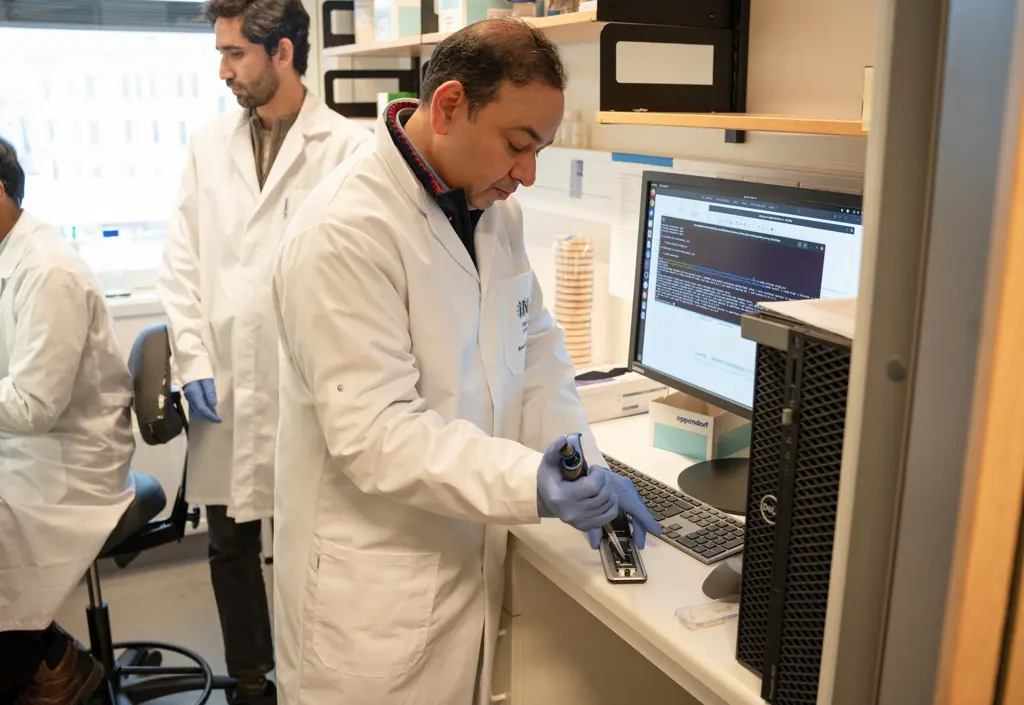
Ahmad says that India and Norway are two very different countries, but with many similarities.
'Family is a high priority in both India and Norway, and that is of course the main reason we chose Norway in the end. We also find many similarities in religious terms. We are Muslims in much the same way that most Norwegians are Christians. We go to the mosque at religious festivals, and beyond that we are mainly concerned with practising the core religious values of compassion for others, which Islam and Christianity have in common.'
A great many people from Asia take a doctorate in Norway, and this is particularly true in technology. In 2025, more Asian than Norwegian nationals were awarded a doctorate in technology in Norway.
Among foreign nationals, German citizens were the largest group to be awarded a doctorate in Norway in 2025, followed by Chinese, Iranian and Indian citizens, in that order, according to Khrono and Statistics Norway. The share from Asia is far lower in mathematics and the natural sciences than in technology.