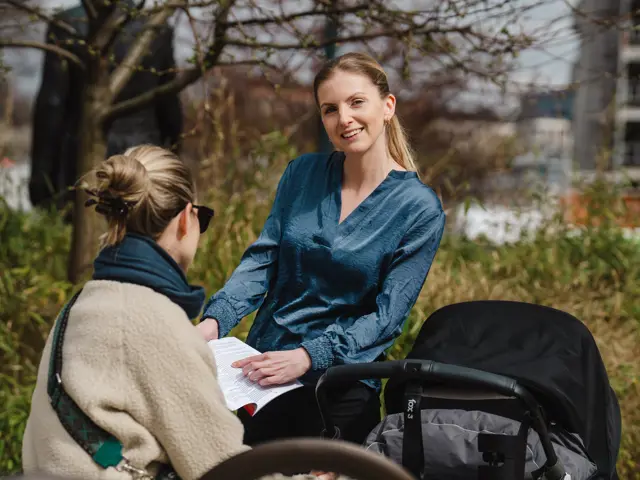

Rikke Ellingsen Hausmann works as assistant director for business areas at Dr. Techn Olav Olsen. Here, she is pictured in a combined playroom and home office.
Took unpaid parental leave to make it all work
“Equality does not necessarily mean splitting parental leave exactly down the middle,” says Tekna member Rikke Ellingsen Hausmann (32). Both she and her husband took unpaid leave while waiting for a kindergarten place.
Recently, NAV published a report showing a sharp increase in the number of women taking unpaid parental leave. From 2008 to 2021, the proportion rose from 18 to 48 percent.
When Tekna member Rikke Ellingsen Hausmann and her husband were expecting their first child, they did not spend much time deciding how to divide their parental leave.
“Without doing a lot of detailed research, we quickly realised that it would make the most financial sense to take 100 per cent parental benefits, even if that meant topping it up with some unpaid leave afterwards,” she says.
For them, unpaid parental leave became a practical solution to make everyday life add up in the period between the end of paid leave and securing a kindergarten place.
“All parents are entitled to unpaid leave immediately after the ordinary parental leave following each birth,” says Tekna lawyer Synne Lüthcke Lied. She advises everyone to familiarise themselves thoroughly with the rules and to carefully weigh the pros and cons before deciding.
Rikke Ellingsen Hausmann gave birth to her first child—who is now five years old—in mid‑February, and her son was offered a kindergarten place the following year, in March. When parents choose to receive 100 per cent parental benefits, the mother is entitled to 15 weeks after the birth, the father is entitled to 15 weeks, and there are 16 weeks that the parents can divide between them as they wish.
“Of the ordinary weeks we were entitled to, I took both the mother’s quota and the part that can be shared between the mother and father. In addition, we took four to five weeks of unpaid leave, which we split equally between us,” says Rikke.
Both Rikke and her husband work in consulting engineering companies, and for them, unpaid parental leave became a practical way to bridge the gap between paid leave and securing a kindergarten place.
Assessing the risk of losing sickness benefits
Rikke explains that they were aware that if one of them took unpaid leave, they could lose their entitlement to sickness benefits from their employer if they became ill. During the first month after returning to work following unpaid parental leave, you are also not entitled to sickness benefits, self-certified sick leave, or care days for a sick child.
Tekna lawyer Synne Lüthcke Lied has the impression that there is a great deal of uncertainty surrounding these rules. She believes the most important points parents considering unpaid parental leave need to be aware of are that you may be entitled to sickness benefits during unpaid leave from day 15 of illness, provided that:
- the unpaid leave is taken immediately after the parents’ ordinary parental leave
- you have an agreement with your employer to resume work
- you can document that the purpose of the leave has fallen away
- you have a sickness benefit basis of at least 1G (the National Insurance basic amount)
“If you are unfortunate enough to fall ill while you are temporarily without income from work, you can apply for sickness benefits from NAV. If the conditions are met, a person on unpaid leave is entitled to sickness benefits amounting to 65 per cent of the sickness benefit basis from day 15 after the start of the sick leave. In many cases, the sickness benefits are paid by the employer, who then receives reimbursement from NAV.”
Rikke and her husband had their second child at the end of February 2019, with the possibility of a kindergarten place in April the following year. This meant that around two months had to be covered by unpaid leave.
“This time, we had more discussion about how to divide the leave. My husband wanted more than just the father’s quota on this occasion. At the same time, it was not an option for me that he should take the entire share that can be divided between mother and father,” says Rikke.
Six months – too early to return to work
She says that she was still breastfeeding both during the day and at night after six months, and that it took a real toll on her energy.
“I get really worked up at the thought that anyone expects you to be back at work after six months. I certainly wouldn’t have managed that,” she says.
“I get really worked up by the idea that anyone expects you to return to work after six months.”
When it came to sharing the leave, they ended up with her husband taking five weeks of the 16 weeks that can be shared with their second child.
She explains that they were a bit more conscious this time about trying to understand the rules when they had child number two.
Once again, they chose to split the period of unpaid parental leave equally.
Rules support gender equality
Rikke says that everything has gone smoothly in relation to her employer.
“I was given a more senior role just before I became pregnant for the second time. My employer did not see this as a problem at all.”
Rikke has not reflected much on the statistics showing that more women are taking unpaid parental leave, but she believes this may be linked to the desire – and the advice – to breastfeed for a longer period.
“The health authorities recommend exclusive breastfeeding for the first six months, and very many women continue breastfeeding to varying degrees after that.”
She does not believe that gender equality necessarily means parents should split parental leave exactly down the middle. In her view, mothers and fathers have different relationships with the child, particularly in the early phase.
Even so, she does not support the idea that parents should be completely free to divide the entire parental leave as they wish.
“Today’s rules help us to create gender equality. When my father took unpaid parental leave with me, he has told me that he was the first man to do so at his workplace,” says Rikke Ellingsen Hausmann, who does not want a return to the days when it was difficult for fathers to gain acceptance for taking parental leave.
More reasons for taking unpaid leave
There may be other reasons for taking unpaid leave than parental leave. Common examples include further education, holding public office, military service, or caring for parents at the end of life.
You can read more about this in Tekna’s advice and guidance on unpaid leave, which explains your rights and what to be aware of when you are temporarily away from paid employment in Norway.